What Lies Beneath the Canopy:Airborne Laser Mapping and Ground Truthing at the Maya site of El Mirador?
with Brigitte Kovacevich and Mike Callaghan
The UCF El Mirador Lidar Project marks the first major archaeological initiative in the El Mirador region in nearly four decades, reviving research at one of the most important Preclassic Maya sites in Mesoamerica. Located within the Maya Biosphere Reserve of northern Petén, Guatemala, El Mirador is known for its monumental architecture and early urban planning, yet its remote location has hindered sustained investigation. This new project, led by the University of Central Florida and funded by Fundación Patrimonio Cultural y Natural Maya (Pacunam), integrates Lidar analysis with field excavation to reassess the site’s development and regional significance. Beginning in 2022, researchers digitized and analyzed LiDAR data covering 512 km² of terrain surrounding El Mirador, followed by ground verification and targeted excavations in 2025. This talk outlines the site’s archaeological and culture-historical background, new project research goals, and advances in lidar mapping. We also share the significant logistical challenges of conducting research in a remote and environmentally demanding setting, from project planning and data acquisition to processing and field verification.
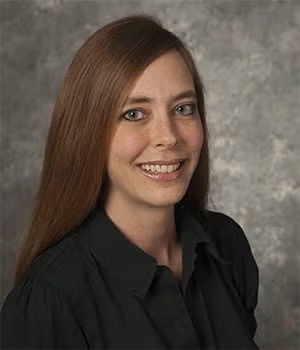
Dr. Kovacevich is a Mesoamerican Archaeologist who works in Guatemala and focuses on the Maya. Her great passion is for Household Archaeology and the investigation of how households were articulated with and foundational for larger social processes like the rise of social inequality, the maintenance of power, and collapse of political systems. She investigates these processes primarily through the analysis of stone tools and adornments with publications on jade production, distribution, and chemical composition with Dumbarton Oaks Research Library and Collection, Trustees for Harvard University (in 2015 and 2021), Heritage Science, Ancient Mesoamerica, and Art of the Ancient Americas at the Dallas Museum of Art, edited by Michelle Rich published by Yale University Press.
Kovacevich has co-directed a project at the Maya site of Holtun, Guatemala investigating the origins of social complexity that resulted in publications in PLOS ONE, Journal of Archaeological Research: Reports, Advances in Archaeological Practice. She currently co-directs a project analyzing lidar data from over 500km2 of the landscape within the Maya Biosphere in Guatemala as part of the Pacunam Lidar Initiative. Her work has been funded by the National Geographic Society and National Science Foundation, American Philosophical Society, Pacunam, The Hitz Foundation, among others.

Dr. Callaghan graduated with his BS (1998) and PhD (2008) from Vanderbilt University. His work on archaeology and ceramic analysis have been published in the journals Ancient Mesoamerica, Latin American Antiquity, Journal of Archaeology Science: Reports, Economic Anthropology, and PLosOne among others. He is also author of the The Ceramic Sequence of the Holmul Region, Guatemala (University of Arizona Press). He is the co-author of the Open Educational Resource (OER) Exploring our World through General Anthropology (UCF STARS) and co-editor of The Inalienable in the Archaeology of Mesoamerica (Archaeological Publications of the American Anthropological Association). Dr. Callaghan’s research also appears in book chapters of edited volumes published by university presses.
Dr. Callaghan is currently co-director of the UCF El Mirador LiDAR Project, which uses Light Detection and Ranging (LiDAR) to identify cultural features in a 500 square km area of the Mirador region (including the site of El Mirador), for purposes of mapping, ground-truthing, and excavation. Prior to his work at Mirador, Callaghan was co-director of the Holtun Archaeological Project, where he investigated the development of social inequality as it relates to crafted objects, public ritual, household activities, and monumental architecture at the site of Holtun, Guatemala. In the past ten years, Dr. Callaghan has received over 1 million dollars in research grants from multiple institutions including the Fundación Patrimonio Cultural y Natural Maya (PACUNAM), the National Science Foundation, National Geographic Society, National Geographic Society/WAITT Program, and University of Central Florida.
At UCF, Dr. Callaghan directs the research of post-doctoral scholars, PhD students, and undergraduate honors students. He teaches courses for graduate and undergraduate students in the areas of general anthropology, ceramic analysis, ethics in anthropology, archaeological pseudo-science, gender in archaeology, and the anthropology of Walt Disney World Theme Parks in Florida.